
DISRUPTIVE / TECHNOLOGY / EXPLAINER
FILE Nº 033
Technology · Explainer
How a Container Moves Through a Port With Almost No One Driving: Inside Rotterdam’s Automated Terminals at Maasvlakte 2
At Maasvlakte 2, on land reclaimed from the North Sea, remotely controlled ship-to-shore cranes hand containers to battery-powered driverless vehicles, which hand them to automated stacking cranes — the chain, step by step, terminal by terminal.
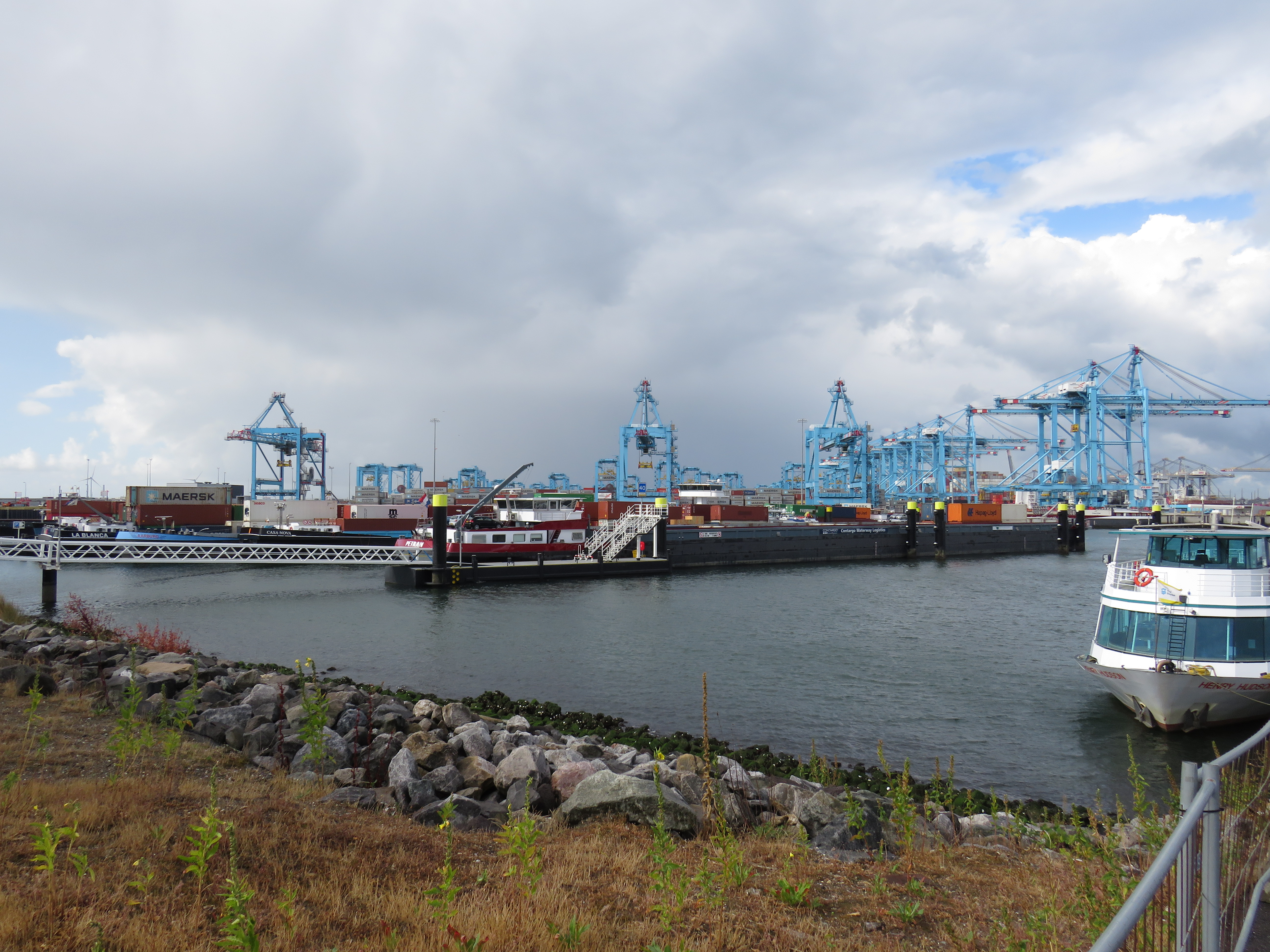
Start with the land itself, because the land is manufactured too. Maasvlakte 2 is the Port of Rotterdam’s extension built out into the North Sea: about 2,000 hectares reclaimed in total, roughly 1,000 hectares of it net usable port and industrial land, with basins about 20 metres deep so the largest deep-draught container ships can berth. The new port area was officially opened in May 2013. Follow one container through it, and the striking fact is how rarely a human being touches the machinery that moves it.
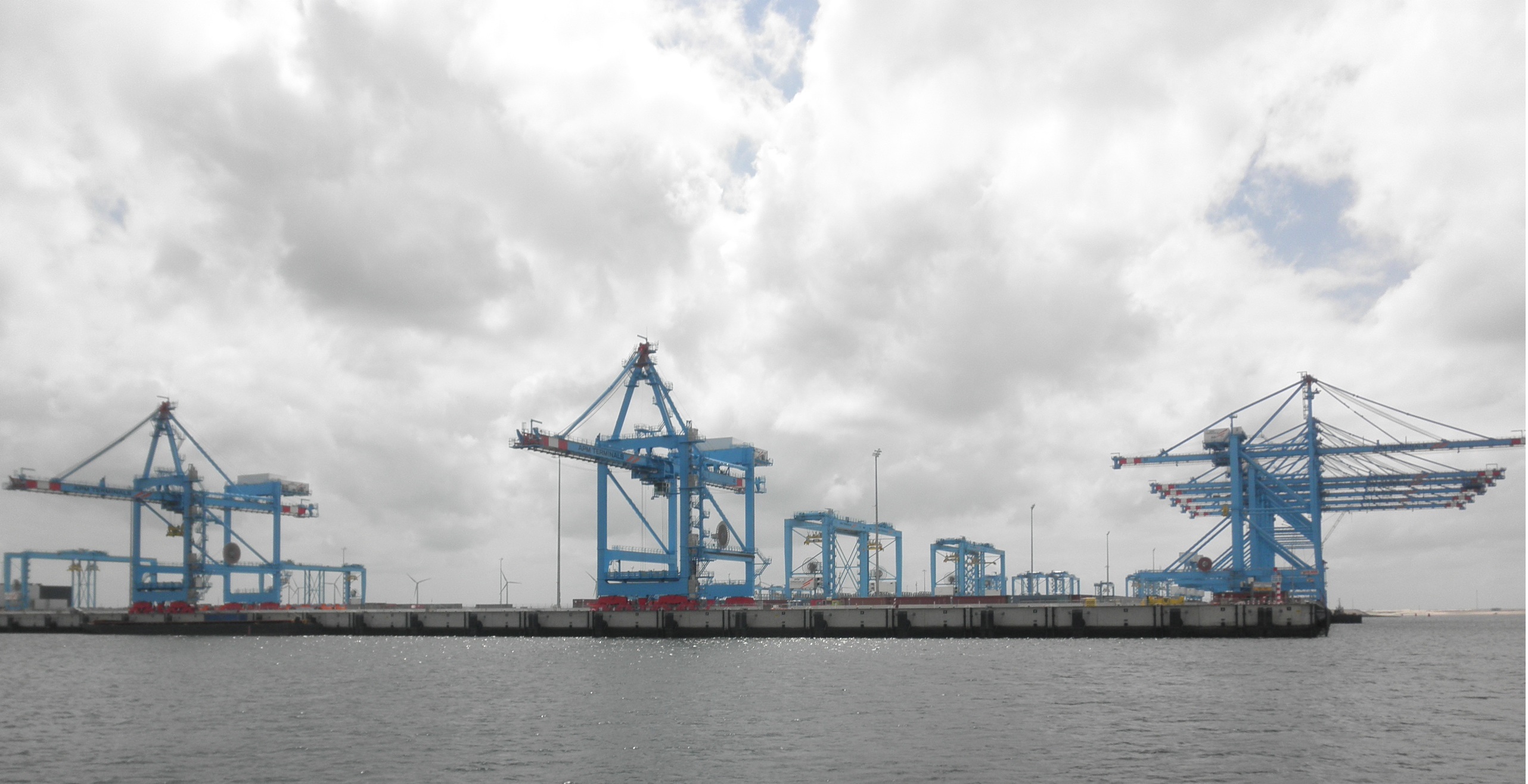
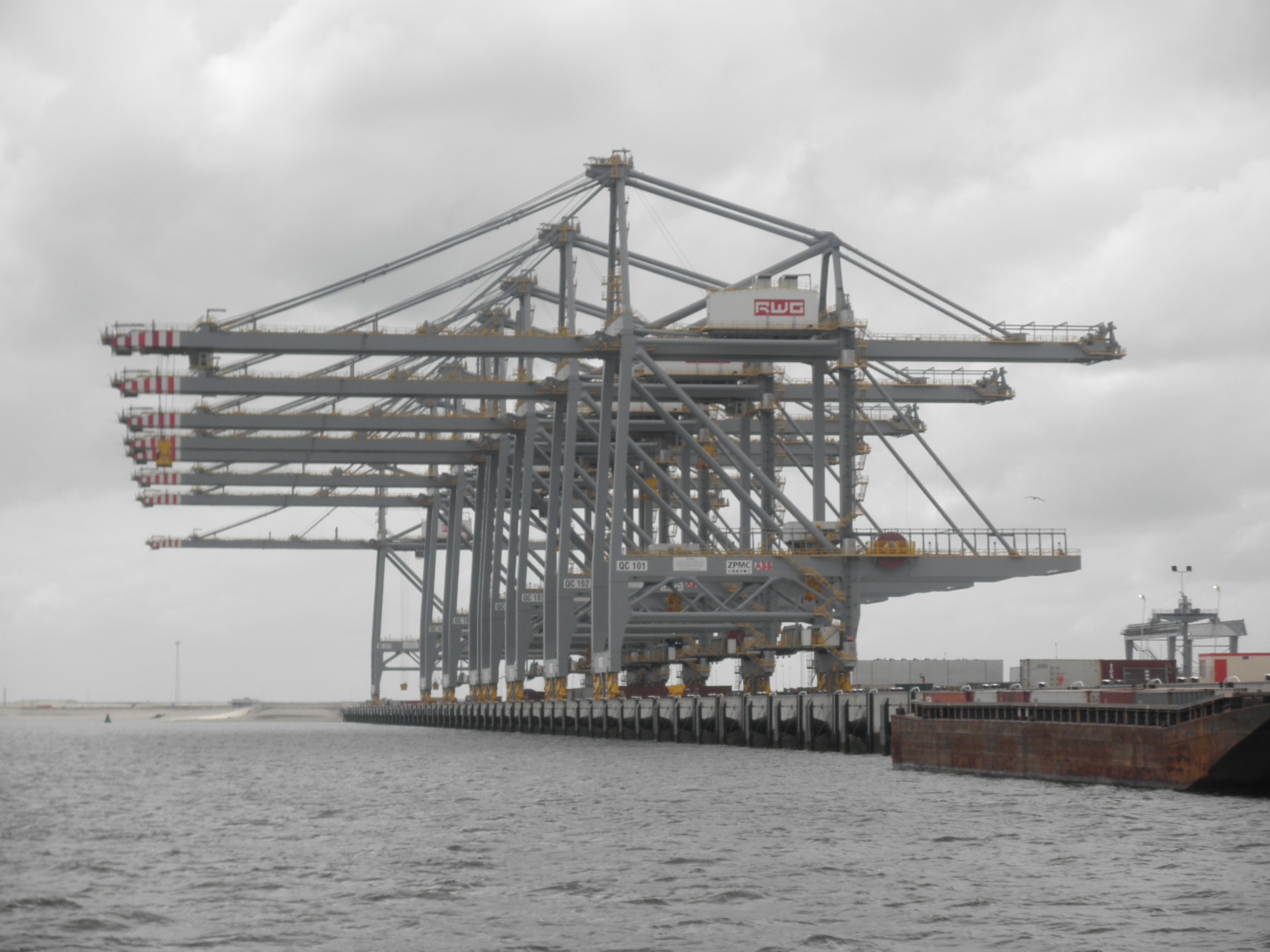
Two automated terminals anchor the container side. The Port of Rotterdam Authority records that APM Terminals and Rotterdam World Gateway (RWG) took the first plots at Maasvlakte 2 and built fully automated terminals that load and unload the largest container ships around the clock. They run the same basic chain with different fleets — worth following step by step.
Step one: the crane is driven from a desk
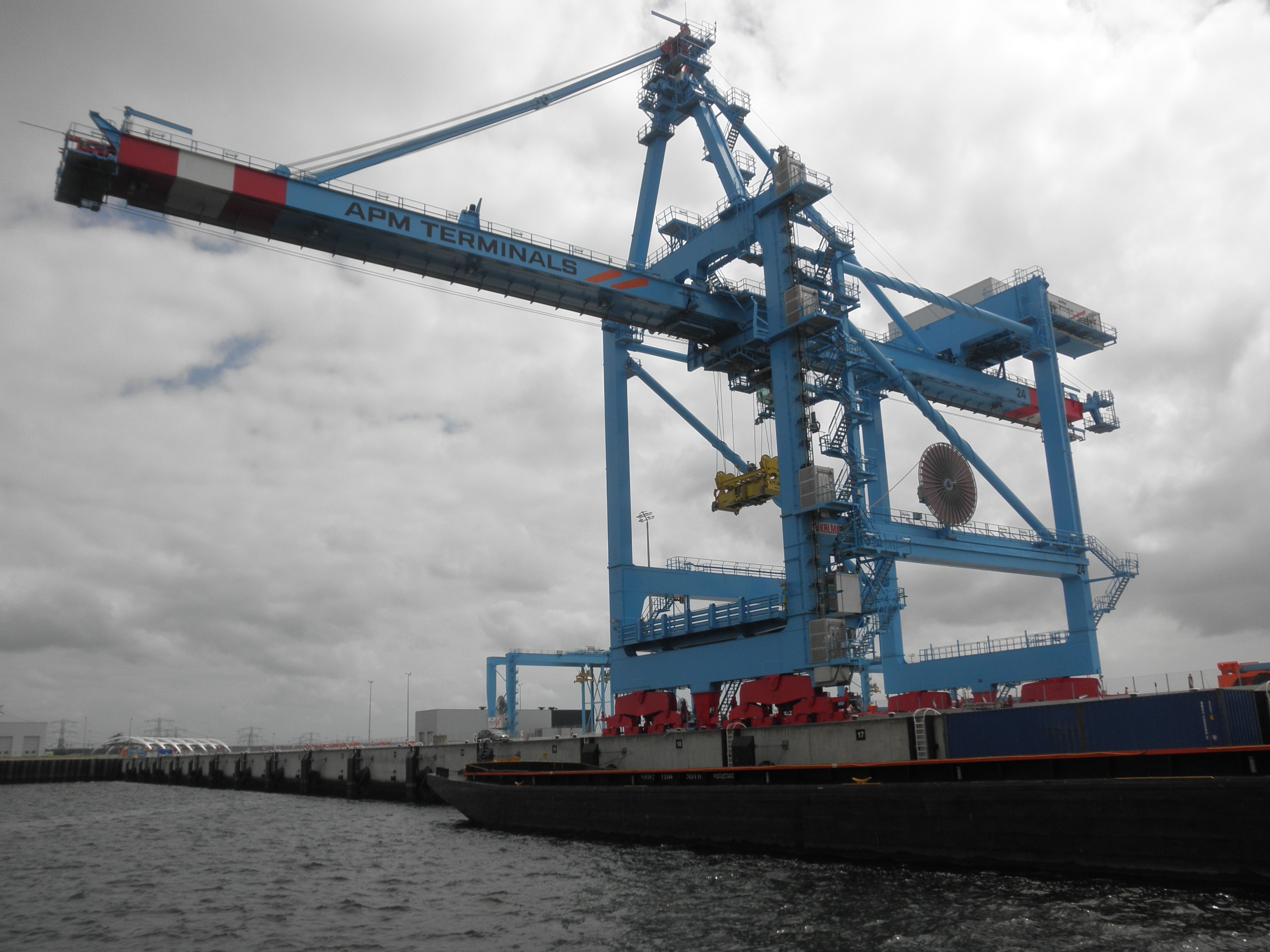
APM Terminals Maasvlakte II was reported at its April 2015 opening as the first container terminal to use remotely controlled ship-to-shore cranes: the operator no longer sits in a cab suspended over the ship, but works the crane from an office. Phase one covered 86 hectares with 1,000 metres of quay, eight electric ship-to-shore cranes and 2.7 million TEU of annual throughput capacity — a TEU being the twenty-foot equivalent unit, the industry’s standard measure of a container.
Step two: a vehicle that lifts
The crane sets the container down not on a truck but on a battery-powered Lift-AGV — an automated guided vehicle. APM’s opening fleet numbered 62 of them. The vehicles follow a computerised transponder grid in the pavement to the yard, can carry two containers at a time, and — a first for AGVs, per the operator’s opening account — can lift a container off themselves and set it into a storage rack, which decouples the vehicle from the crane: neither waits for the other. Battery packs were rated for about eight hours, with robotic battery-exchange stations swapping them automatically.
Step three: the stack runs itself
In the yard, automated rail-mounted gantry cranes — ARMGs, 54 of them in APM’s opening fleet — take the box from the rack and position it in a high-density stack, then retrieve it for its onward leg: the rail terminal, a waiting truck, or another yard position. During quiet periods the system grooms the yard, restacking boxes so that the next vessel’s load plan is easier to reach. The stack is not a parking lot; it is a machine that continuously rearranges itself.
The other terminal, the smaller crew
Rotterdam World Gateway, which officially opened on 11 September 2015, runs the same chain with its own fleet: at opening it was reported with eleven deep-sea cranes, three barge and feeder cranes, two rail cranes and 50 automatic stacking cranes. Its then managing director put the daily operating team at no more than 10 to 15 people, out of 180 employees — most of them IT specialists. That staffing shape is the real story of the automated terminal: when cranes and vehicles are electric, remote and automated, the scarce skill shifts from driving to software, planning and handling the exceptions the software cannot.
“We are, in fact, an IT company that handles containers”
— Ronald Lugthart, Managing Director, Rotterdam World Gateway
Out by water and rail
Maasvlakte 2 was laid out as a multimodal hub, designed to shift hinterland traffic from truck to barge and rail. Both terminals have barge quays and on-dock rail, and APM’s Lift-AGVs serve the barge and rail facilities as well as the deep-sea quay. RWG’s first phase was described as 108 hectares with a 1,150-metre deep-sea quay and a separate 550-metre barge quay, with 59 computer-controlled electric AGVs planned for quay-to-stack transport. Both terminals run electric equipment: APM reported no on-site CO2 emissions from terminal operations, powered by renewable energy, and RWG’s fully electric cranes were described as running on green energy. The honest limit is the writer’s own conclusion: automation does not abolish congestion. It moves the bottleneck — from the quay, to the software, the planning, and the landside interfaces where the automated yard meets the unautomated world.
Keep reading
More from the filing cabinet.
Features · Retrospective · Europe–North America · transatlantic
Concorde at Fifty: The Airliner That Flew at Twice the Speed of Sound — and Outran Its Own Economics
On 21 January 1976 two Concordes lifted off at the same moment, from London and Paris, and passenger flight went supersonic for 27 years. Fifty years on, with NASA’s X-59 supersonic and the FAA rewriting the rule that confined Concorde to the oceans, the question it posed — how much is time worth? — is open again.
Business · News · Asia · South Korea
Humanoids Are Becoming the Memory Industry’s Next Growth Engine
Counterpoint Research expects DRAM demand from humanoid robots to rise more than twentyfold by 2030 — and Samsung and SK Hynix want the AI data-center playbook to repeat.
Technology · News · Europe · Dresden, Germany
Dresden’s Billion-Euro Bet on Chips for the Physical World
GlobalFoundries has topped out its €1.1 billion SPRINT fab expansion and unveiled FDX Fusion — a chip platform designed for what the industry now calls Physical AI.