
DISRUPTIVE / TECHNOLOGY / EXPLAINER
FILE Nº 034
Technology · Explainer
Lifted by Rainwater: How the Panama Canal’s Locks Raise a Ship 26 Metres, With No Pumps
A ship crossing Panama climbs three lock steps to a lake 26 metres above the sea, floats across, and steps down the other side. The machinery is gates, valves and gravity; the engineering, step by step, in both generations of locks.
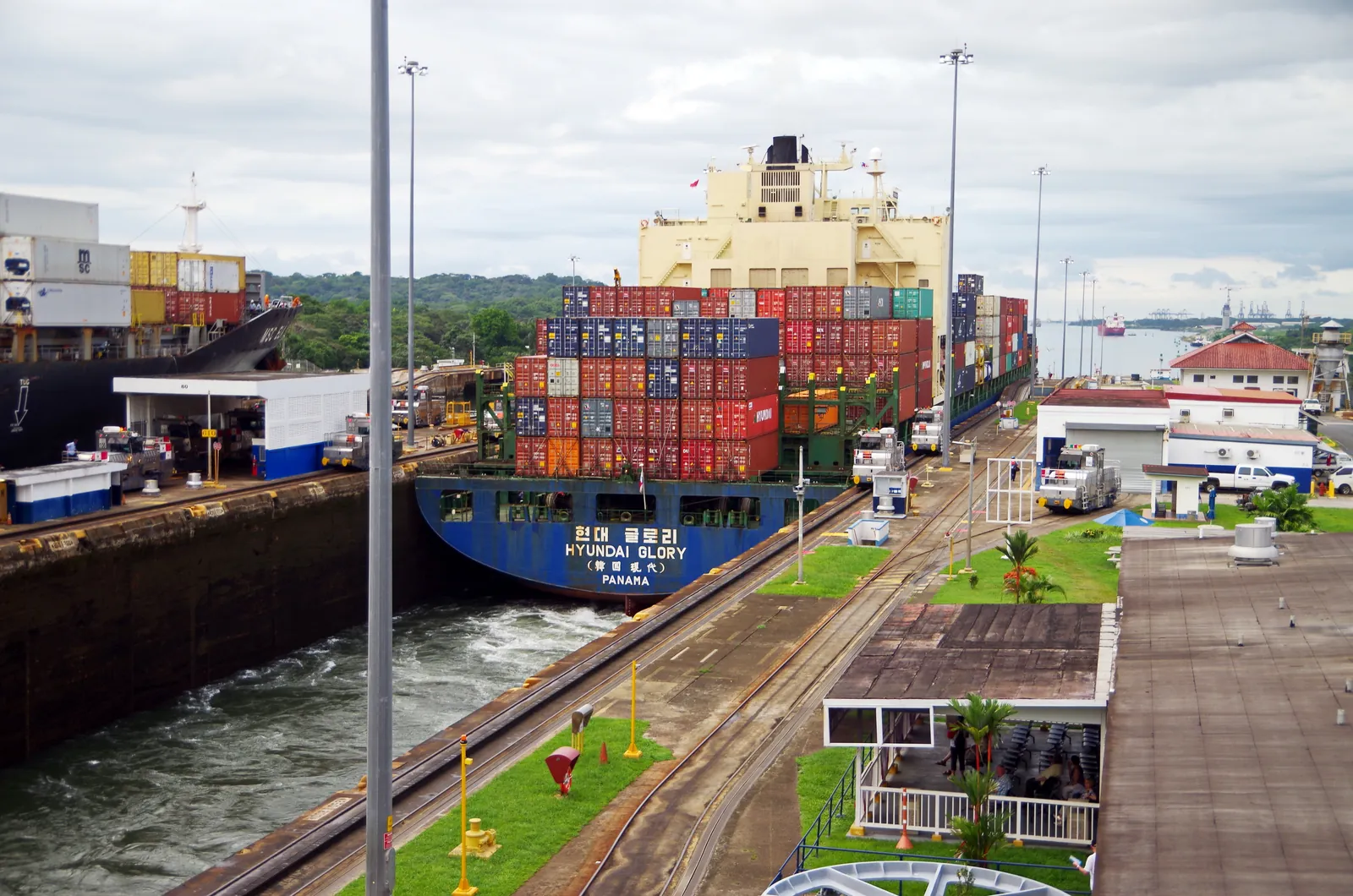
Start with the problem the locks solve. The Panama Canal does not cut through the isthmus at sea level. Its summit is Gatún Lake, an artificial lake 26 metres, about 85 feet, above the sea, and every ship that transits must be lifted to that height and lowered again on the far side. The lifting machinery is the lock system, and its working fluid is the lake itself: fresh water, impounded rain, flowing downhill by gravity alone.
“No pumps are used at the Panama Canal, the water does its work by force of gravity alone”
, Panama Canal Authority, Design of the Locks
Step one: into the chamber
The original locks, opened in 1914, are arranged as staircases. On the Atlantic side, the Gatún Locks climb in three steps; on the Pacific side, a ship descends one step at Pedro Miguel and two at Miraflores, where the lift varies between roughly 43 and 64.5 feet with the Pacific tides. The locks are built in pairs, two parallel lanes of six chamber pairs, twelve chambers in all, and every chamber is the same size: 1,000 feet long and 110 feet wide, about 304.8 by 33.5 metres. A ship enters a chamber under its own power, the gates close behind it, and the chamber becomes a lift.
Step two: the water does the lifting
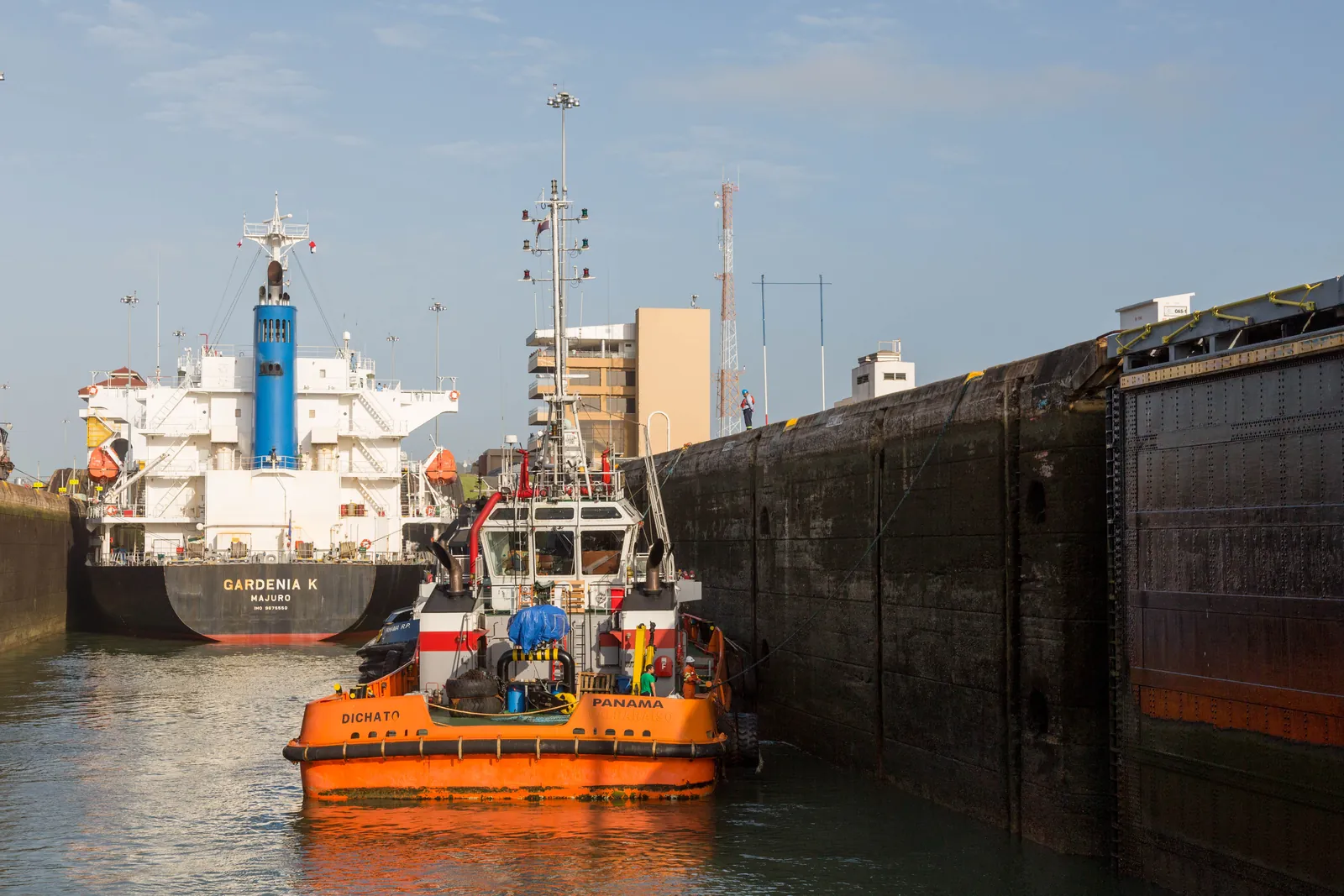
Each chamber is served by culverts built into its walls, 18 feet in diameter, feeding twenty cross-culverts that open through one hundred openings in the chamber floor. To fill the chamber, the valves at the lower end are closed and the valves at the upper end opened; water rushes in from the higher level through the floor, and the ship floats upward. A chamber fills in roughly eight to ten minutes. To empty it, the valve sequence reverses and the water drains to the lower level. Nothing is pumped at any point. The gates at each end are miter gates, paired steel leaves that meet at a shallow angle pointing upstream, so the pressure of the higher water seals them tighter; each leaf is about 64 feet wide and 7 feet thick, and the leaves range from 47 to 82 feet tall depending on their position, the tallest at lower Miraflores against the Pacific tides.
Step three: the mules hold the ship straight
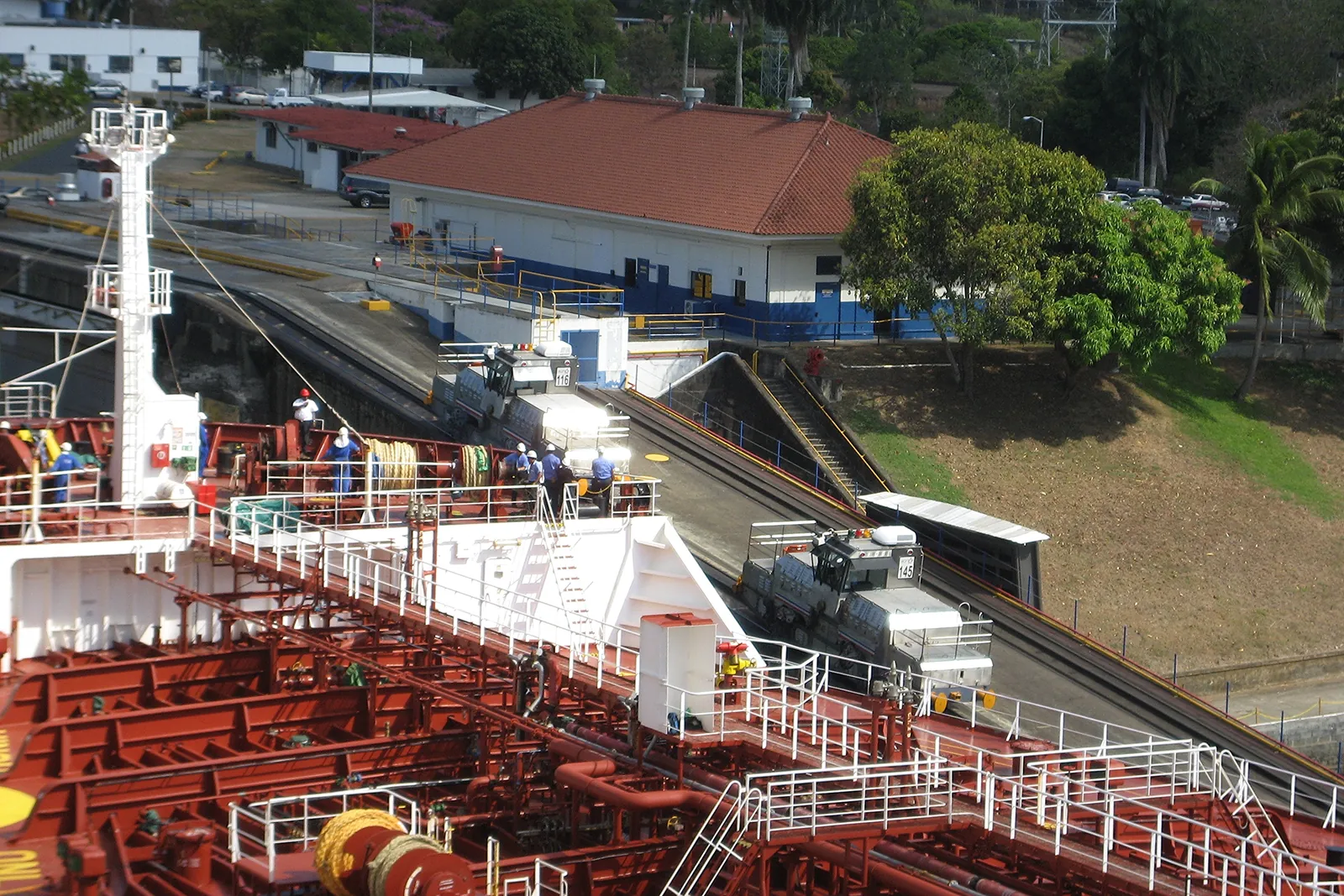
Inside a chamber only feet wider than the ship, positioning is everything. That is the job of the mules, electric towing locomotives that run on cog tracks along the lock walls. The ship moves under its own power; the mules, made fast to it by wire cables, control its lateral position and braking, at about two miles per hour, and climb inclines of up to 45 degrees between lock levels. A regular Panamax transit uses six locomotives and twelve wires; the largest vessels take eight locomotives and sixteen wires. The Panama Canal Authority’s operating fleet numbers about one hundred locomotives.
The price of the system is paid in water. Filling one chamber takes about 26.7 million US gallons, and a full transit through the original locks discharges roughly 52 million gallons of Gatún Lake fresh water to the sea. That arithmetic, multiplied by every ship, is why the lake’s level is a strategic variable, and why drought years force the Authority to cut the number of daily transits.
The bigger staircase, 2016
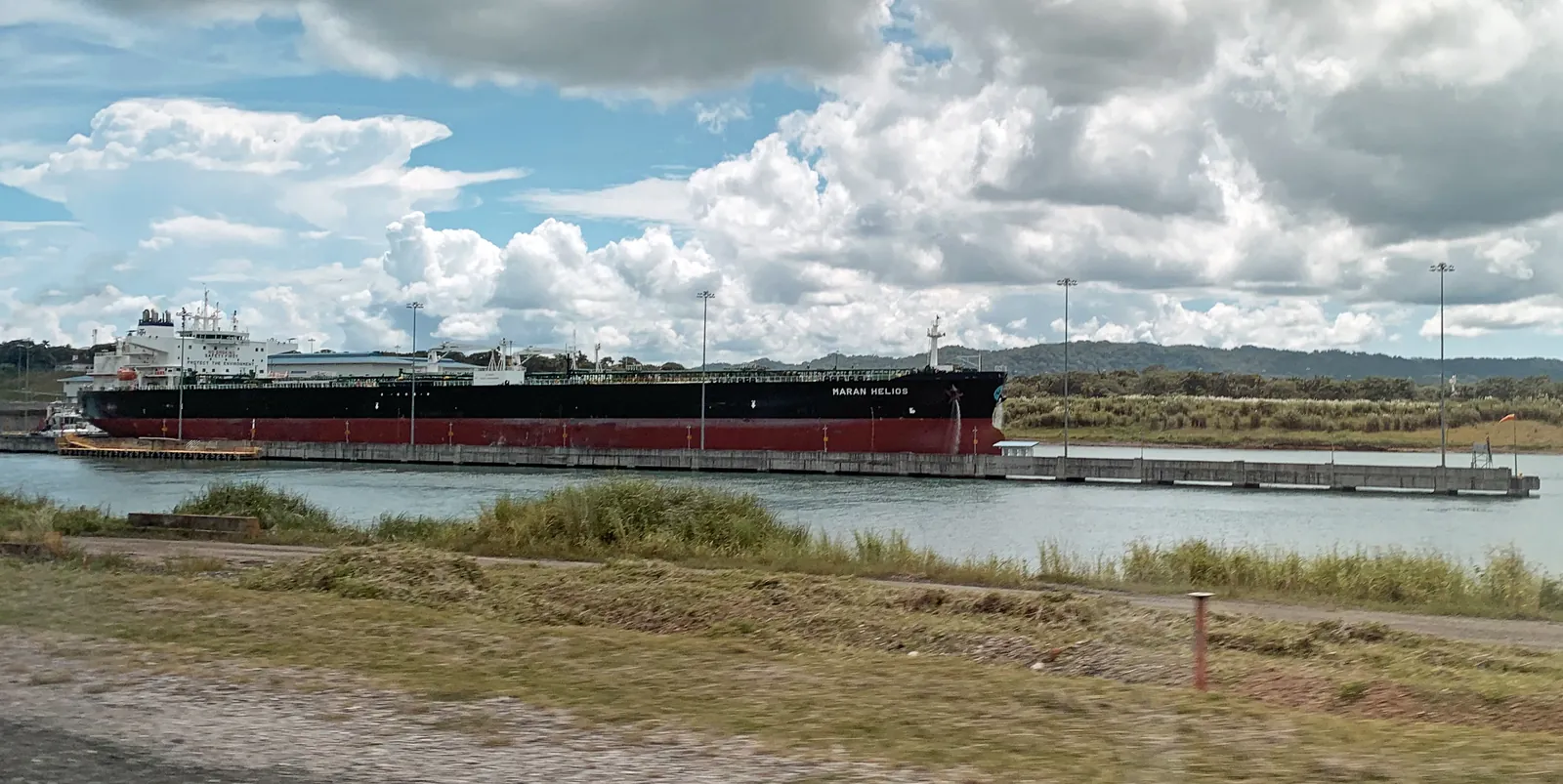
The Neopanamax locks, Agua Clara on the Atlantic side and Cocolí on the Pacific, opened on 26 June 2016 after a construction programme that began in 2007 and cost $5.25 billion, approved by more than 75 percent of voters in a 2006 referendum. Their chambers are far larger, 427 metres long, 55 metres wide and 18.3 metres deep, three chambers in each complex, and the design differs in two telling ways. The gates are rolling gates that slide sideways into recesses rather than swinging, and there are no mules: tugboats position the ships. Beside each chamber sit three water-saving basins, eighteen across both complexes, which capture and recycle 60 percent of the water used in each lockage, so a Neopanamax lockage uses about 48 million gallons despite serving a much larger ship. The first transit was made by the container ship COSCO Shipping Panama, 299.98 metres long with a beam of 48.25 metres, carrying 9,472 TEU.
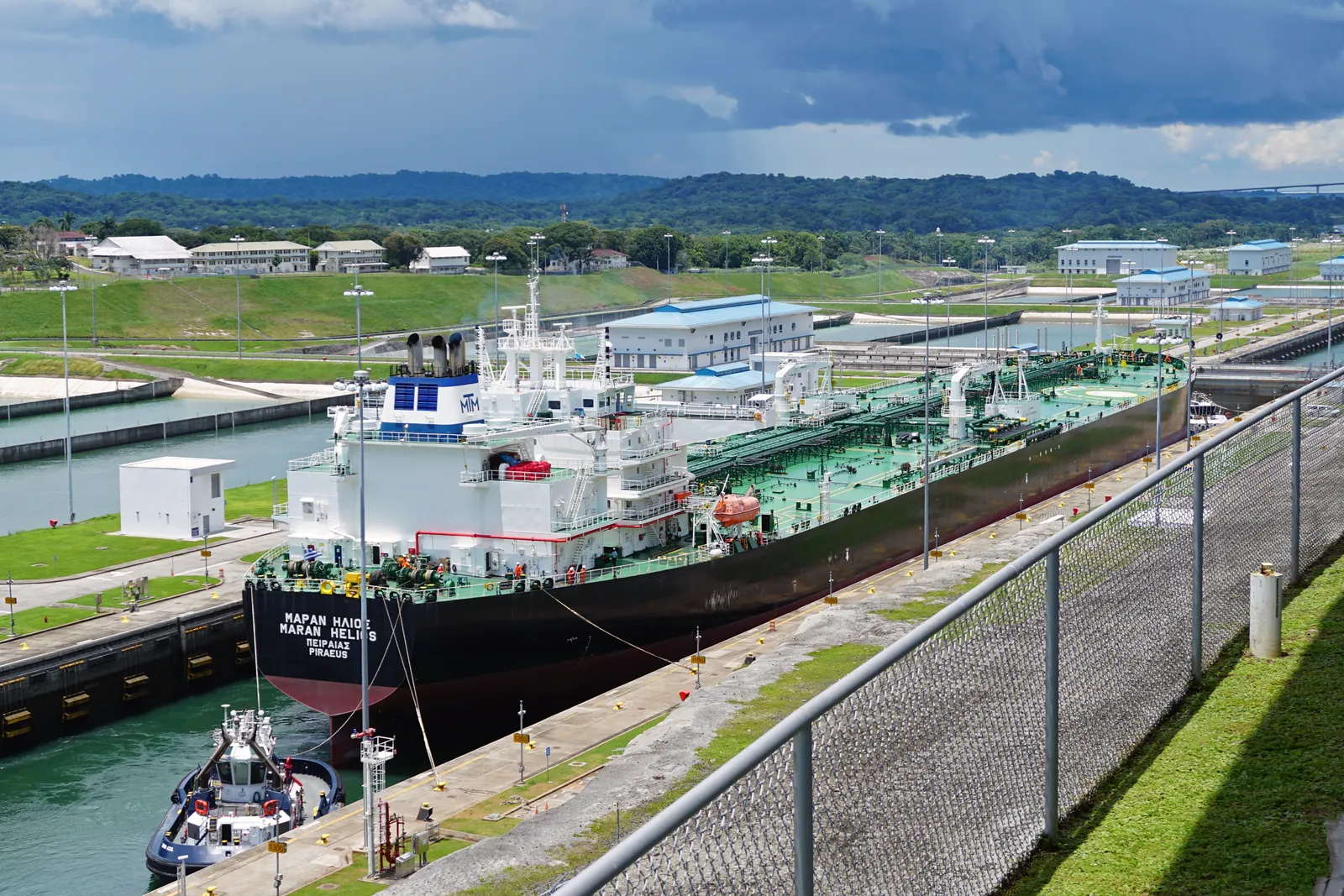
Size is the locks’ real output. The original chambers cap a ship at 294.13 metres overall for container and passenger vessels, a beam of 32.31 metres and a draft of 12.04 metres in tropical fresh water, roughly 5,000 TEU of containers: the dimensions the industry still calls Panamax. The new locks admit 366 metres overall, a beam of 51.25 metres since June 2018, a draft of 15.24 metres and more than 14,000 TEU. In its fiscal 2026 results the Authority counted 13,951 transits and 521 million tons through both lock systems, with booked transits averaging 11.59 hours in transit in September 2026. The disruption is a century old and still compounding: a staircase of water, climbed by gravity, that sets the maximum size of a large share of the world’s fleet.
Keep reading
More from the filing cabinet.
Technology · Explainer · Asia · Japan
The Train That Floats on Cold: How Japan’s Superconducting Maglev Works
JR Central’s SCMaglev carries its magnets at minus 269 degrees, floats ten centimetres above its guideway, and holds the world rail speed record at 603 km/h. With the Shizuoka Alps tunnel approved in July 2026, the line it was built for is unblocked at last.
Technology · News · Europe · Dresden, Germany
Dresden’s Billion-Euro Bet on Chips for the Physical World
GlobalFoundries has topped out its €1.1 billion SPRINT fab expansion and unveiled FDX Fusion, a chip platform designed for what the industry now calls Physical AI.
Innovation · News · North America · United States
Washington’s $350 Million Quantum Wager: From Blueprints to Hardware
DARPA advanced four more companies to the final stage of its Quantum Benchmarking Initiative, while the Pentagon lined up a conditional $150 million loan for PsiQuantum’s factory.