
DISRUPTIVE / TECHNOLOGY / EVERGREEN
FILE Nº 006
Technology · Evergreen
Moore’s Law at Sixty: What Gordon Moore Actually Predicted
It wasn’t a law, it wasn’t about speed, and the doubling period changed. The most famous prediction in technology, read properly.

In 1965, Gordon Moore — then director of research and development at Fairchild Semiconductor — was asked to contribute to the thirty-fifth-anniversary issue of Electronics magazine. His assignment: predict the next ten years of semiconductor components. His response, “Cramming more components onto integrated circuits,” became the most famous forecast in technology history.
What Moore observed was simple: the number of components on a chip had been doubling roughly every year. Extrapolating a decade ahead, he estimated that the microcircuits of 1975 would contain some 65,000 components per chip.

“The complexity for minimum component costs has increased at a rate of roughly a factor of two per year. Certainly over the short term this rate can be expected to continue, if not to increase.”
— Gordon Moore, “Cramming more components onto integrated circuits,” Electronics, 1965
A decade later, seeing complications ahead, Moore revised the cadence to a doubling roughly every two years — and the revised version held, approximately, for the next forty years.
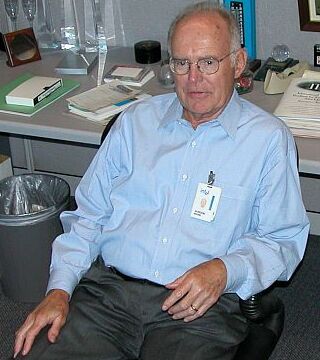
An economic observation, not a physics law
Moore’s point was about cost, not speed. “I wanted to get across the idea that this is the way we’re going to make cheap electronics,” he later said. “The nature of the whole industry is the more stuff you can put on a chip, the cheaper it is per unit of stuff.”

That economic framing is why the “law” mattered: it gave the entire industry a shared roadmap. For five decades, product plans and manufacturing strategies were drawn against the expectation that chips would keep getting denser and cheaper — a self-fulfilling prophecy funded by the industry it described.
Is it over?
The obituaries come regularly. In September 2022, Nvidia CEO Jensen Huang considered Moore’s law dead — while Intel’s then-CEO Pat Gelsinger held the opposite view. The truth is more prosaic: classical transistor shrinking has slowed, and the industry now chases progress through new materials, new architectures, and advanced packaging as well as raw density.
Sixty years on, Moore’s real prediction holds up better than the law named for him: that making electronics cheaper would create markets nobody had imagined. The doubling was the mechanism. The cheapness was the point.
Keep reading
More from the filing cabinet.
Features · Retrospective · Global · the physical world
The Year Compute Went Physical
2026 was the year the chip industry stopped designing for the cloud and started building for the world of atoms — robots, factories, and machines that sense, think, act, and communicate.
Technology · Evergreen · Global · the adoption curve
The S-Curve: Why Technologies Arrive Slowly, Then All at Once
Every technology feels inevitable after the fact. The most useful model of how adoption actually unfolds is more than sixty years old — and still explains why the future arrives late, then early.
Technology · Evergreen · Global · the instruction set
Open Source Comes to Silicon: The RISC-V Explainer
The most important layer of the computer is the one nobody sees. For sixty years it was proprietary. A 2010 summer project at Berkeley set out to change that.