
DISRUPTIVE / TECHNOLOGY / EXPLAINER
FILE Nº 040
Technology · Explainer
A Telescope That Unfolds: How the James Webb Space Telescope Works
Webb’s mirror is too big for any rocket, its sunshield is the size of a tennis court, and it must stay colder than deep winter in space to see the first galaxies. The engineering, fold by fold.
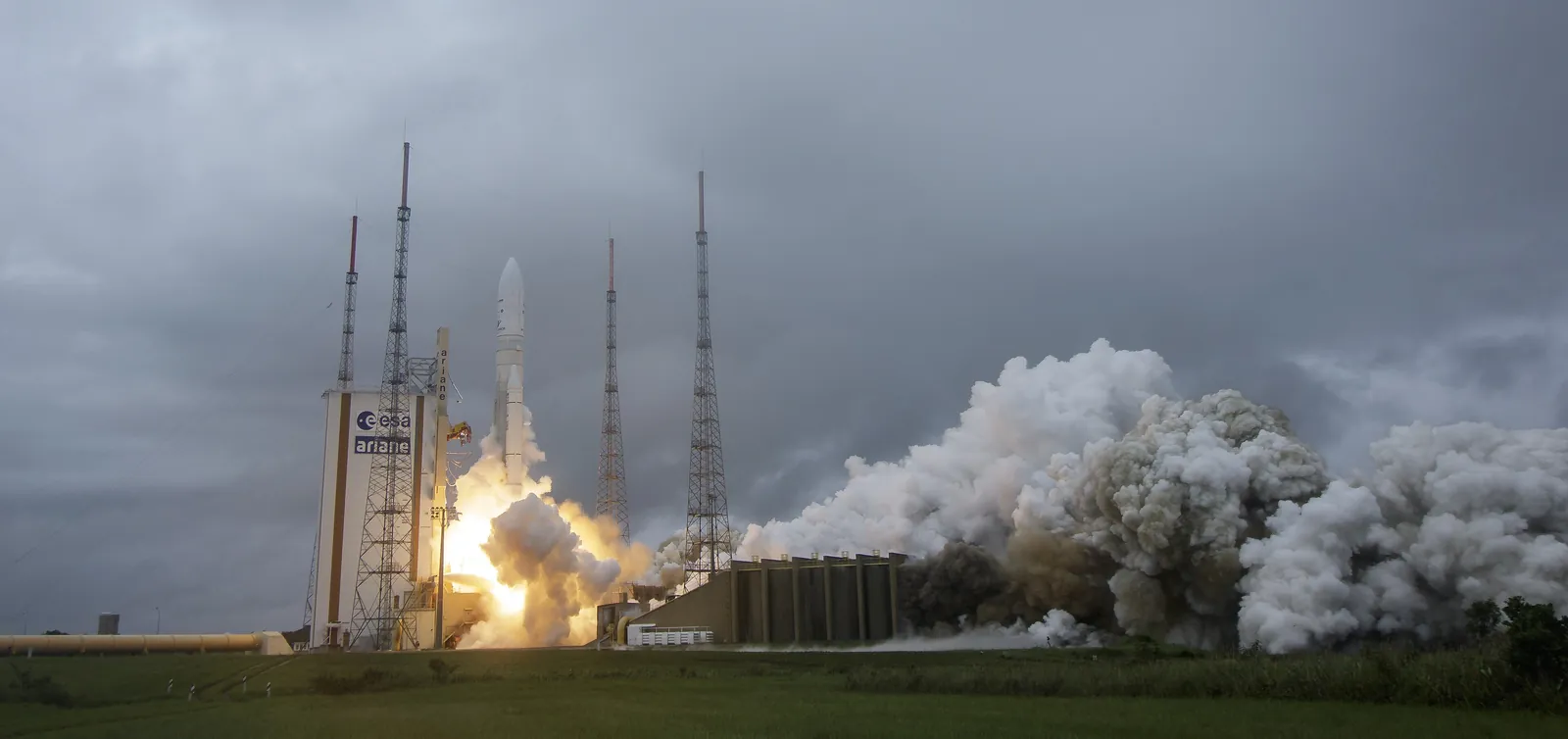
The James Webb Space Telescope had to solve a packing problem before it could solve any astronomy. Its primary mirror spans 6.5 metres, far wider than the fairing of the Ariane 5 rocket that carried it, and its sunshield is larger still. So Webb launched folded, origami-style, to about a quarter of its full size, and spent its first two weeks in space unfolding: 50 major deployments in sequence, every one of which had to work. It is an international partnership between NASA, the European Space Agency and the Canadian Space Agency, with Northrop Grumman as prime contractor.
The mirror: 18 pieces of gold-coated beryllium
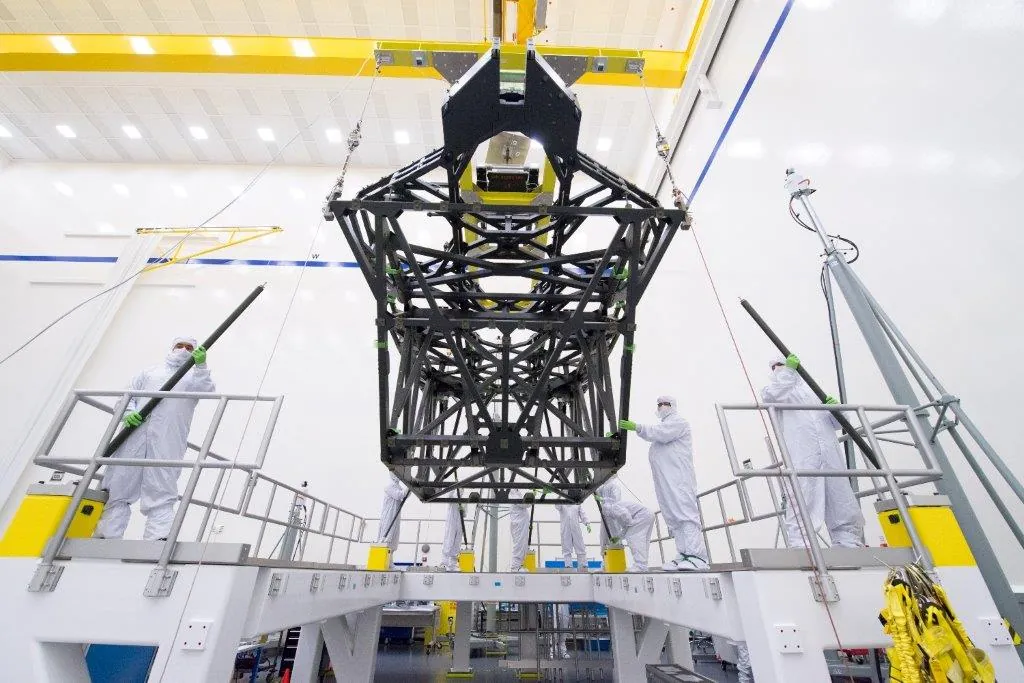
The primary mirror is not one mirror but 18 hexagonal segments of beryllium, a metal chosen because it is light, stiff and holds its shape at extreme cold. Each segment is coated with a microscopically thin layer of gold, which reflects infrared light superbly; the gold across the whole mirror amounts to about 50 grams. Together the segments form a collecting area of about 25 square metres, roughly six times that of the Hubble Space Telescope and its 2.4-metre mirror. The two outer sections of the mirror are wings that folded back for launch and swung into place in space, the last of them latching on 8 January 2022. In operation the 18 segments are aligned by actuators to behave as a single mirror, focusing infrared light onto a smaller secondary mirror and from there into the instruments.
The sunshield: five layers between fire and ice
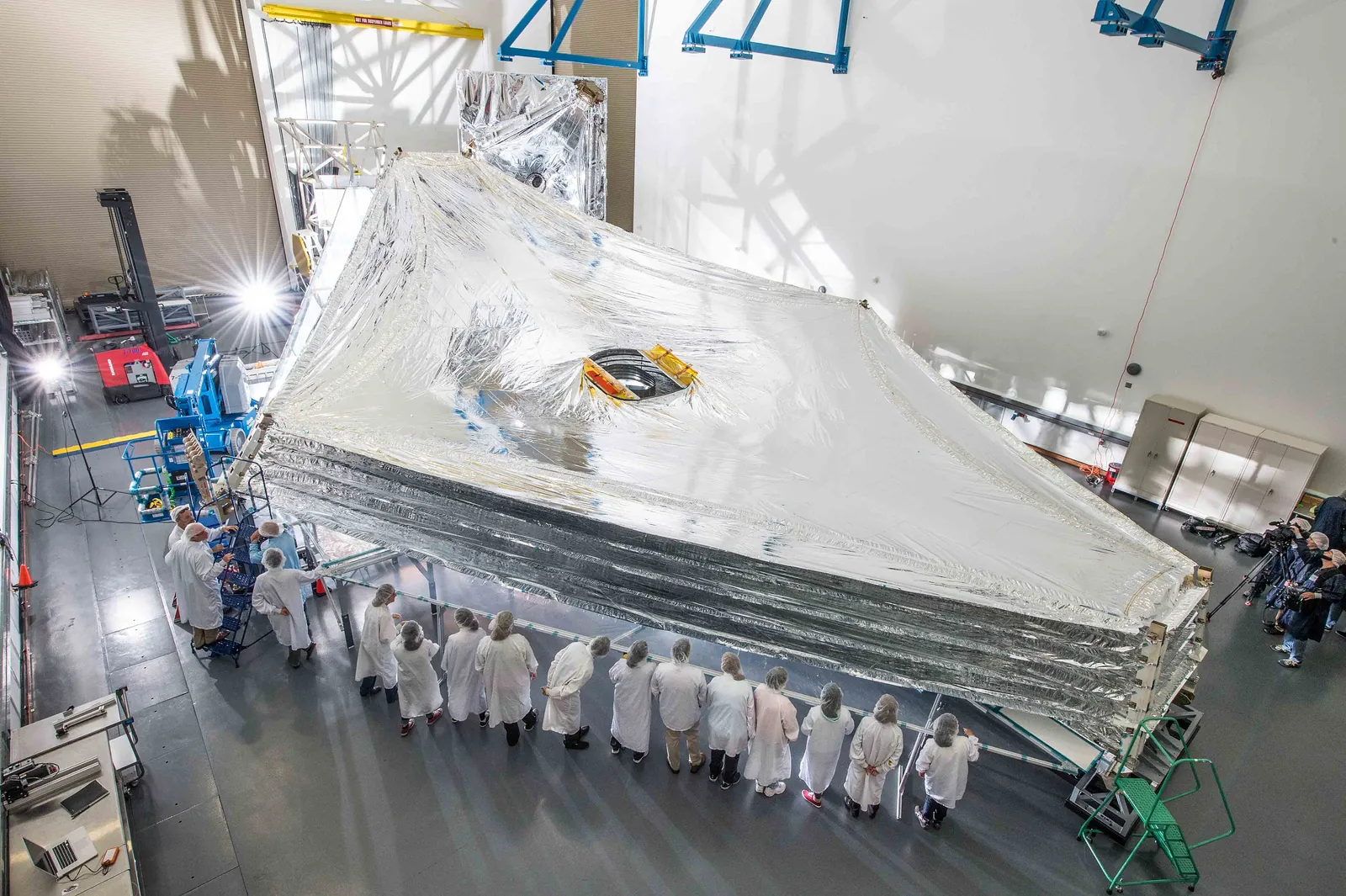
Webb observes infrared light, which is heat radiation, so a warm telescope would be blinded by its own glow. The defence is the sunshield: five membranes of Kapton film, each thinner than a human hair, stretched to 21.2 by 14.2 metres, about the size of a tennis court. Each layer is cooler than the one before it, shedding heat to space at every step, so the telescope side sits in permanent shade at below about 50 kelvin while the Sun-facing side bakes. One instrument, the Mid-Infrared Instrument, needs to be colder still and is chilled by a mechanical cryocooler to a few degrees above absolute zero. Tensioning the sunshield, unrolled and pulled taut by cables and pulleys over several days in early January 2022, was the deployment engineers feared most.
The address: a halo around nothing
Webb does not orbit the Earth. It orbits the Sun in step with Earth, looping around the second Lagrange point, L2, a gravitational balance point 1.5 million kilometres away on the side of Earth opposite the Sun. From that halo orbit the Sun, Earth and Moon always sit in the same direction, behind the sunshield, so one shield guards against all three at once and the telescope can watch the rest of the sky uninterrupted. Webb launched from Europe’s Spaceport at Kourou, French Guiana, on 25 December 2021 at 12:20 UTC, deployed its solar array about 30 minutes later, and fired its engine on 24 January 2022 to enter the L2 halo orbit, a month after launch.
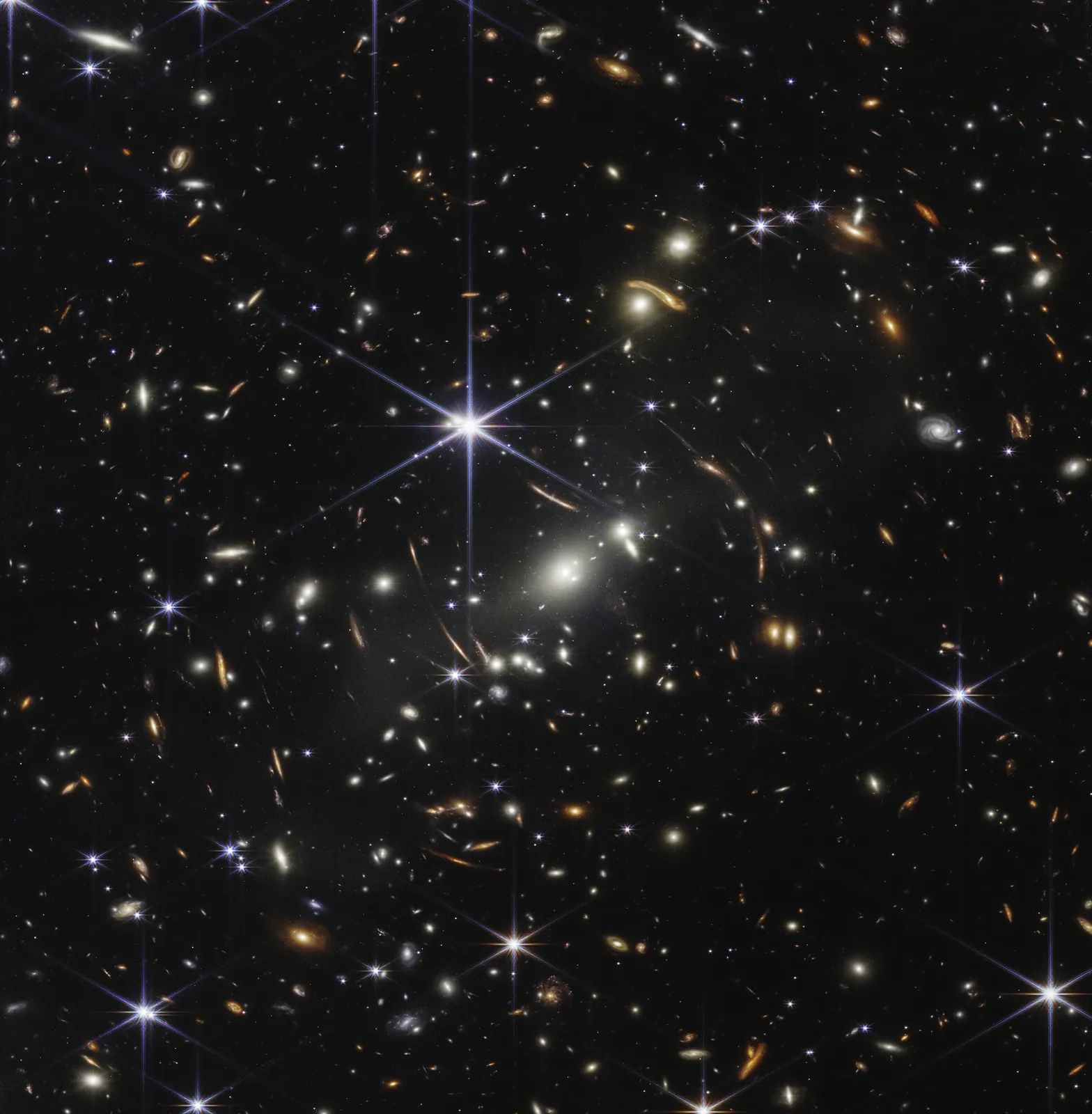
What the machine is for is time travel of a literal kind. Light from the first galaxies has been stretched by the expansion of the Universe into the infrared, and Webb was built to catch it: NASA describes a telescope designed to see the epoch when the first stars and galaxies formed, more than 13.5 billion years ago, and also to study planets and bodies inside our own solar system. Its first full-colour images and spectra were released on 12 July 2022, after six months of commissioning. The disruption is a design philosophy made physical: when the instrument you need cannot fit in the rocket that exists, you do not shrink the instrument. You teach it to fold.
Keep reading
More from the filing cabinet.
Technology · News · Europe · Dresden, Germany
Dresden’s Billion-Euro Bet on Chips for the Physical World
GlobalFoundries has topped out its €1.1 billion SPRINT fab expansion and unveiled FDX Fusion, a chip platform designed for what the industry now calls Physical AI.
Innovation · News · North America · United States
Washington’s $350 Million Quantum Wager: From Blueprints to Hardware
DARPA advanced four more companies to the final stage of its Quantum Benchmarking Initiative, while the Pentagon lined up a conditional $150 million loan for PsiQuantum’s factory.
Features · Evergreen · Global · the idea, not a place
What “Disruptive” Actually Means
The word on our masthead has a precise definition, and most people use it wrong. A field guide to Clayton Christensen’s theory, thirty years on.